
Here’s a review I wrote for Pleiades (29.2: 2009) on the occasion of the publication of Barbara Guest’s mighty Collected Poems, edited by her daughter Hadley (who was also a fabulous resource for interviews, cool old photos and memorabilia, and uncollected texts which I refer to in the piece– thanks Hadley!).
DEFENSIVE RAPTURES: ON THE COLLECTED POEMS OF BARBARA GUEST
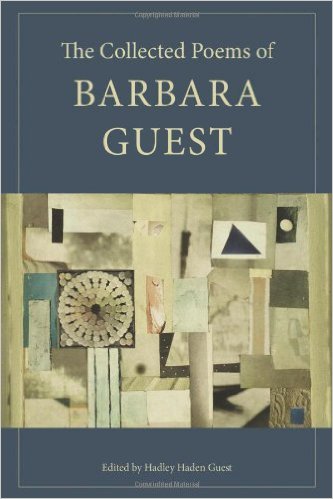
Barbara Guest, The Collected Poems of Barbara Guest
Edited by Hadley Haden Guest
Wesleyan University Press, 558 pages. $39.95
 At the crack of the 1950s, Barbara Guest moved to New York in a convertible. She was penniless, bringing along only her wits and a painter boyfriend she’d met through Henry Miller. She was a smart, reticent young woman, who wrote smart, reticent, painterly poems—a natural person of culture, an observer, an outsider. In the belly of the loud male-dominated scene of Abstract Expressionism, she took up art criticism; she married twice; she went to parties with Frank O’Hara; she drank at the poets’ bars and the painters’ bars; she befriended artists like Joan Mitchell, Helen Frankenthaler, and Mary Abbott; she wrote on their canvases or they worked side by side. The first poem in her first book (1960’s The Location of Things) drops the reader all at once into the astounding familiar:
Why from this window am I watching leaves?
Why do halls and steps seem narrower?
Why at this desk am I listening for the sound of the fall
of color, the pitch of the wooden floor
and feet going faster?
Am I to understand change, whether remarkable
or hidden, am I to find a lake under the table
or a mountain beside my chair
and will I know the minute water produces lilies
or a family of mountaineers scales the peak?
The answers to these questions—the forty-five years of poetry that make up Wesleyan’s new Collected Poems of Barbara Guest—are easy to miss at first look. In fact, Guest’s body of poetry is best characterized by what it leaves out. Her twenty-odd volumes siphon away assertion, scorn biography, challenge denotation, skip exposition, temper humor, and warp experience. What’s left is Imagination, the same visionary strain of Keats and Adorno, Stevens and Baudelaire; a pre-postmodern sort of ecstatic displacement, from the world of facts into the world of interrelation. Her work glows.
Although she shared a nest with the New York School poets—with Frank O’Hara, John Ashbery, James Schuyler, and Kenneth Koch—and although O’Hara was a passionate advocate of her poetry and a devoted friend, her poetics (or her “comportment,” in Susan Gevirtz’s phrase) fundamentally differs from theirs. She doesn’t fit in, and never founded, a particular avant-garde school. Her mixture of heavyweight aesthetic theory, gorgeous musicality, and a reticent, private voice has never really been emulated. Although the much-missed Sun & Moon Press afforded a national audience for her work from the late 1980s to the 90s, her early volumes have been hard to come by and her poems are underanthologized. There are other poets of Guest’s generation (Jack Spicer, Philip Whalen, Edward Dorn, Aram Saroyan) who have also been unjustly neglected. But Guest is a better poet than all of them, and this Collected Poems is a terrific volume gathered rather too late: after an unbelievably productive final fifteen years, Guest died in Berkeley, two years ago, at age 85.
 Jay Aquinas Thompson
You must be logged in to post a comment.