
Here’s a 2011-or-so piece I published online with Poetry Northwest that seems to have since dematerialized from their webspace. Enjoy.
Amadon, Samuel. Like a Sea. USA: University of Iowa Press, 2010.
Groves, Daniel. The Lost Boys. USA: University of Georgia Press, 2010.
Willis, Elizabeth. Address. USA: Wesleyan University Press, 2011.
HEADLANDS AND HEADSTONES: NEW BOOKS BY SAMUEL AMADON, DANIEL GROVES, AND ELIZABETH WILLIS
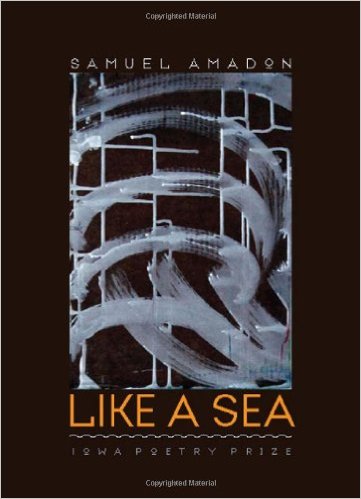 Robert Frost once asserted that the poem begins in delight and ends in wisdom—“the figure is the same as for love.” Samuel Amadon’s Like a Sea and Daniel Groves’s The Lost Boys, both debut collections, express delight through very different temperaments, and conclude (if that’s the right word) in wildly divergent sorts of intelligence. In her fifth book, Address, Elizabeth Willis delights in juxtaposition and slippage, seeming wiser through an adamant refusal of book-smarts.
A first look at Samuel Amadon’s poetry suggests the academic, ambiguous, “well-wrought” American poetry of the 1940s and 50s. You can hear Wallace Stevens in his inquisitive, investigative language:
Were I to ask where you were staying
would that be what moves our conversation
beyond whether repetition
has more to offer than repetition
will be enough when I say
it has been enough is not enough… (20)
But, as this quotation suggests, his syntax is oddly-wrought and tricky; his poems hazard more than they assert. What is enoughness, in speech, understanding, acquaintance? The tercets Amadon is fond of (also Stevens-y at first look) wobble beneath the reader like three-legged stools, preventing her from feeling entirely stable or balanced within the poems. This imbalance is most pleasurable when it matches the poems’ logical upsets, the back-and-forth of Amadon’s continuous present:
I could not sound like anyone to anyone,
but often meant to almost (as
rocking is from weaving) sound
local, as there should be more
local, I started staying here, how-
ever I sounded saying
I can be here again, saying it over
in a way so it piled, in a way
piling, as we cannot see it
ending, where it is from, the reason for
it is in fact frightening
to hear so much anywhere in anyone (39).
 Jay Aquinas Thompson
You must be logged in to post a comment.