
Robert Christgau isn’t dead. He slips on his orthotics and goes to shows; he listens closely to many hundreds of new records a year and writes beautifully about dozens of them. I don’t want to wait until the 75-year-old rock critic kicks the bucket to consider his virtues and talk about how much I love him.

Christgau at home. Image lifted from Brooklyn Magazine profile “The Dean’s List”
Christgau’s lifelong affection for the rock and roll’s collective cultural appeal, physical pleasure, and black-led but deeply integrated racial history has made him prickly toward those who apply high-art ambitions to the genre. It’s also made him unusually sensitive, as white critics go, to the ways that race and racism play out in rock and roll.
As early as 1967, mainstream tastemakers began to embrace the more ambitious white West Coast and English rockers as “geniuses” making “art” in the mixed idiom of rock and roll, conferring a cultural legitimacy (and a European Modernist heritage) on their cryptic lyrics and heady, baroque arrangements. This legitimacy would long elude, say, black geniuses in the rock and roll tradition, from James Brown to Holland-Dozier-Holland. Surveying the white-dominated, “forward-thinking” scene at that year’s Monterey Pop Festival, Christgau noted that he didn’t see anyone there who felt their music had a kinship “with, say, Martha and the Vandellas.” As rock became “art,” with the racial baggage this implied, Christgau stuck with his own sense of pleasure as a critic, refusing to take surface opacity for depth.
And as recently as last year, he noted that the much-maligned hit-factory style currently dominating pop—where beatmakers shop their rhythms to producers who match those backing tracks to a series of hookwriters and then to a singer—had at last undone the Eurocentric tradition of songwriting credits (and royalties) being divided between the lyricist and melodist. For decades, the rhythmmakers—the crew that carries the song’s heartbeat, the people who make a good tune a hit—being consigned only to per-session payment, or at best a small slice of royalties. Now, thanks to the hit factory, they’re the first ones getting paid.
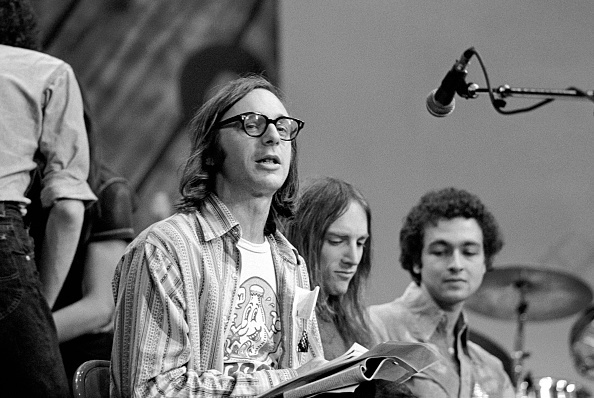
1978. Lifted from Pacifica’s website: http://www.scpr.org/
He has the kind of beautifully subtle distinction in his listening that comes from paying close attention to his own sense of pleasure ahead of—and sometimes against—critical chatter. His acuteness means he can find things to admire and enjoy even in records that make him uneasy or that he’s inclined to strongly dislike. He’s not afraid to speak in moral terms about records he finds revolting. Plus, of course, his writing’s polish and concision means he can say/evoke/riff on/crack wise about a lot in very few words. It remains damn refreshing to read criticism that (to echo a formulation from writer Carl Wilson) works hard to locate for whom, to whom, and by what channels a work of art speaks: Christgau’s criticism is social, free of bohemian chauvinism. It’s also refreshing that, though Christgau has zero interest in making himself like something, he’s willing to ask himself what it’s like for him to like something, and share the fruits of this question with his readers.
(This is not to cover up some obnoxious moments in his writing—at one point referring to Hendrix, an artist he adored, as a “psychedelic Uncle Tom”; making a nasty sexist quip about the Donnas; chastising Nas and Damian Marley’s critical Afrocentrism by informing them that critical dissent is protected thanks only to the European Enlightenment. And, of course, sometimes I find his reviews reactionary or misguided or etc. He’s written a lot.)
And then, of course, there are the fruits of his work. Through his inimitable and seemingly inexhaustible Consumer Guide (14,000 reviews there to browse), I’ve discovered easily a hundred completely-new-to-me-at-the-time records I now adore. (Surely I’m not the only one to trawl Spotify with his A-pluses in a separate tab?) This spring alone I’m getting to know Wussy’s Funeral Songs, Kate & Anna McGarrigle’s Tell My Sister rarities collection, the Three Tenors of Soul’s All the Way from Philadelphia, Sly & Robbie Present Taxi, Sam Mangwana’s Maria Tebbo twofer, Amy LaVere’s Hallelujah I’m a Dreamer, and Ornette Coleman’s Of Human Feelings. He hates metal; he’s grossed out by most jazz fusion; he detests prog rock. But he’ll listen attentively to it three times before he tells you so.
Christgau, I look forward to years of not-having-to-miss-you-yet.
Love
JAT
 Jay Aquinas Thompson
You must be logged in to post a comment.