Category Archives: spirit

Speaking of Which

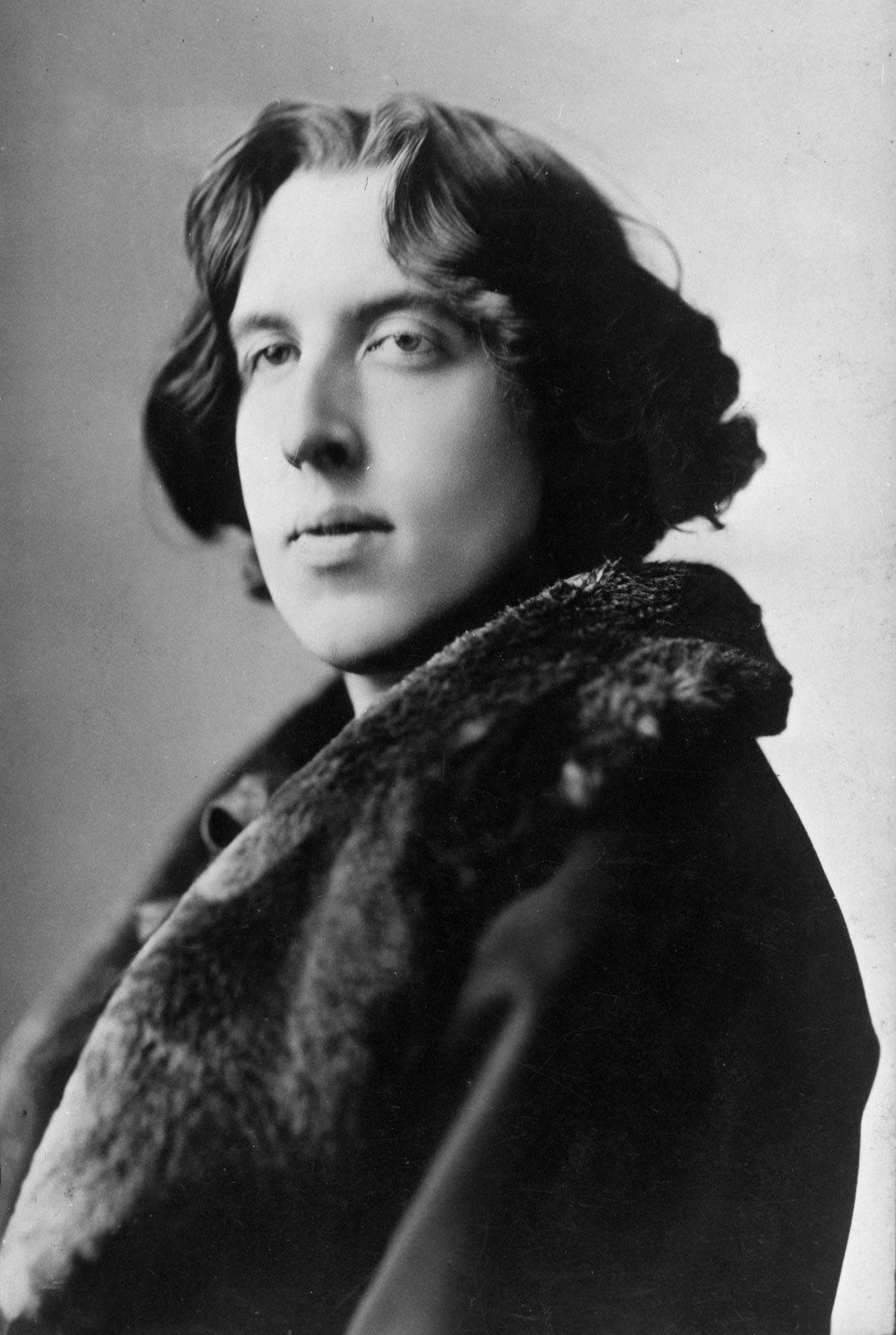
oscar-wildeA thought that ties into my post here Monday. From Oscar Wilde’s essay “The Soul of Man under Socialism”:

“The message of Christ to man was simply ‘Be thyself.’ That is the secret of Christ.

“When Jesus talks about the poor he simply means personalities, just as when he talks about the rich he simply means people who have not developed their personalities. Jesus moved in a community that allowed the accumulation of private property just as ours does, and the gospel that he preached was not that in such a community is is an advantage for a man to live on scanty, unwholesome food, to wear ragged, unwholesome clothes, to sleep in horrid, unwholesome dwellings, and a disadvantage for a man to live under healthy, pleasant and decent conditions. Such a view would have been wrong there and then, and would of course be still more wrong now and in England; for as man moves northwards the material necessities of life become of more vital importance, and our society is infinitely more complex, and displays far greater extremes of luxury and pauperism than any of the antique world.

“What Jesus meant was this. He said to man, ‘You have a wonderful personality. Develop it. Be your self. Don’t imagine that your perfection lies in accumulating or possessing external things. Your perfection is inside of you. If only you could realize that, you would not want to be rich.

“‘Ordinary riches can be stolen from a man. Real riches cannot. In the treasury-house of your soul, there are infinitely precious things, that may not be taken from you. And so, try so to shape your life that external things will not harm you.'”

Comments Off on Speaking of Which

Filed under politics, spirit

My Queerness, My Male Privilege, and My Catholicism

Reflecting on a responsibility to myself I’ve failed to fully keep: living my full self candidly in all my communities.

Part of my reverence for Catholicism, my embrace of it as a worldview, has to do with the deep importance of the body in Catholic faith life. The standing and kneeling. The dousing with holy water and the heavy earthy reek of real frankincense and the real flowers wilting and the real bloody sweetness of the wine. The weak and emaciated body on the cross instructing us in God’s willing embrace and redemption of all that’s bodily: our physical infirmity, our historical contingency, our subjection to arrogant power, our radical weakness, our possibility of freely-chosen solidarity and our passage into death: death the darkest shadow of all those cast by this beautiful and bleeding creation, the shadow twinning all its light, and God passing through it. I revere communion as a foretaste of our unity, body and soul, with God. We know God in our bodies: our bodies are not a shell or a sinker dragging our featherweight spirits into temptation: they’re braided up with our souls.

This is important because, in my experience of sexuality as well as of spiritual ecstasy, I feel brought close to the edge of my finitude. Karl Rahner said once that humans are incomplete beings oriented toward completeness. In spirituality as in sexuality, I feel a deep intimation of a unity that I as an incomplete being won’t definitively achieve in life but I can sense, unbearably close, overpowering and out of reach.

I feel all this wisdom in Catholicism, so deeply that it breaks my heart how deeply dehumanizing church teachings are on queer sexuality (especially queer sexuality, I should say) and women’s reproductive freedom.

Friends who I love– friends who are radically open to God, friends doing the work on Earth I’d call kingdom-building, friends in touch with a profound awe at the mystery of our existence– can’t find a home in my faith community. Who could blame them, when Church teaching calls queer sexuality “intrinsically disordered” and Francis compares the spectrum theory of gender to nuclear weapons for how both harm “the order of creation“? My parish is blessed to be home to an open, affirming, and progressive community; our families look many different ways; our parishioners and pastors were deeply involved with the “Catholics for Marriage Equality” campaign; but the weight of the Church’s own teachings hangs over all of us and our work.

And I, for my part, have made my home in my parish while hedging on a deep part of myself: I’m a queer person in a loving partnership with a woman. I’m queer in my range of attractions, queer in my romance, queer in my relationship’s experience of and agreements around intimacy– a queer person who passes, often willingly, as straight in much of my faith community (plenty of other spaces too). I’ve passed by choice and habit and a deeply internalized fear of exposure: an invisible fear, a matter of adjusting my habits and managing others’ expectations, rather than fleeing or explicitly denying anything.

The consolations of this act of passing– fitting in and tending to others’ expectations– are bogus. Can I pretend my heart is hidden from God? (Thinking of Luke 12:3.) This choosing to pass is also a failure of responsibility to friends who can’t choose to pass: I let them stay other in the eyes of my faith community, even of prospective allies in my faith community. This consolation also can’t compare to the joy I feel when I truly acknowledge and welcome my whole extravagantly sissy, tender, outrageous self. There’s a simplicity in this acknowledgement that I’m taking a deep breath and embracing. I believe doing this will bring me more harmony with the embodied qualities of Catholic faith I love, and more courage in speaking up against the aspects of the Catholic understanding of the body that I resist.

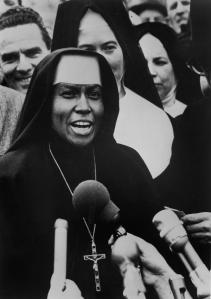
Speaking of which, I’m feeling more and more acutely the cost of being a man in an institution as foundationally sexist as the church. The Catholic church is the church of Mary, Ruth, Miriam, Julian of Norwich, St. Theresa, Flannery O’Connor, Sr. Mary Antona Ebo, Teresa Forcades i Vila OSB, Dorothy Day, Mairead Maguire, Milet Mendoza, Eleanor Josaitis, Sr. Helen Prejean: women on fire with the Spirit. But the Church’s name and might has also been, again and again, a means of controlling women throughout history, relegating them to a smaller humanity than men. The Church’s denial of the priesthood to women is offensive. It’s one of the distortions– like Augustine’s justification of forced conversions from, of all things, Christ’s parable of the great banquet– that come from rationalizing the arrangements of power in the societies where the Church had been invited to share that power.

The practice of church doctrines on sexual responsibility are, I believe, one aspect of this diminishment and devaluation of the female. Instantiated in everything from the Church’s extensive charitable work to its Sunday school, this doctrine falls punitively (and almost exclusively) on women, on the female body as a site of male power and control. For repeating the sin of Eve, a woman’s atonement will be acceptance of a child she may have no means to care for and no support in raising. In my stinging conscience, I’m aware of how my comfort as a man in a male-dominated institution has sometimes dulled my resolve to speak out about sexuality, female empowerment, and abortion to my Catholic spiritual siblings, and my resolve to show visible solidarity with others who do so.

I love Catholicism for the age and weathered grandeur and extravagant patchiness of its cultural and ecclesial life. It reflects many societies, many ways of knowing. The Church’s very human overelaboration– of ritual, artifice, decoration– doesn’t match the grandeur of God. But this overelaboration is, to me, a more beautiful sort of failed attempt than that of the hard-pew, bare-cross Presbyterianism I was raised in. I feel I belong in the Church. I write candidly about sexuality and institutional sexism here not out of a fantasy of reshaping the church to suit my experience, but because it feels poisonous to belie my conscience by omission. “He who acts against his conscience always does moral evil.” My resolution is to risk discomfort more in search of truer harmony and joy, and to give more labor and solidarity to those doing kingdom work in the church itself.

Thanks to A and G who urged me to find the courage to speak all this. Thanks to J for shining a light for me on women leaders, lay and religious, in the church.


Comments Off on My Queerness, My Male Privilege, and My Catholicism

Filed under politics, spirit

Reflection for Solemnity of Mary, Mother of God (Jan 1)

Here’s the reflection I gave at St. Mary’s on New Year’s Day for the Solemnity of Mary, Mother of God. 

In the course of my week, I feel closest to worship between about 5:30 and 7 in the morning. When I can get myself out of bed for it, this is my quiet time—the time before I wake Finn up and start the process of getting him to preschool and myself to work. I spend that quiet hour and a half at my desk with a cup of coffee, a little lamp, three prayer candles, and a glow-in-the-dark statue of Mary that my friend Alex gave me when we were both baptized.

With the candles lit, I offer my prayers and fears and hopes and longings for the day or the week, read a Psalm, sometimes write a poem, sometimes reflect in my journal on a sentence or two from the gospel. Then I wake Finn up, and my day starts. I like to believe that the fruits of this silent time are everywhere in the rest of my day: I notice that I’m less crabby, neurotic, and exhausted by dinnertime if I’ve taken the silence of the morning to draw myself closer to God and just quiet down.

Mary’s power and receptivity, her prophetic gift and the holy dignity she brings to our human body, are at the heart of my understanding of my faith. I’m obsessed by the Magnificat, her prophecy at the beginning of Luke; I’ve been trying to memorize it line by line on my morning commute, and I’m about halfway through. The fire and timeless beauty of those words burn my heart.

But in today’s gospel, I’m drawn not to Mary’s words, but to her silence. “Mary kept all these things, reflecting on them in her heart.” What is it, I wonder, that Mary is keeping in her heart? We hear that all who heard the shepherds were amazed: I can only believe that Mary, too, was dumbfounded at the confirmation of the visit of the angel, at the suggestion that this tiny, quiet person swaddled in her lap would make real her own prophecy. This silence of her reflection continues long after the astounded shepherds go back to their flocks. How can we know what sort of thoughts must be turning over in her? How can any of us fathom the impossible gift of Christ to the world?

Today in Numbers, we heard the blessing: “The LORD let his face shine upon you, and be gracious to you.” This blessing, it seems to me, is precisely what Mary assented to: the Lord shone upon her, in her “yes” to the angel, in taking on the bodily work of carrying the child of the Holy Spirit, in accepting a love and trust that will ultimately pierce her like a sword. And here it is, unbelievably, coming to pass nine months later.

In the Magnificat in the first chapter of Luke, Mary, pregnant with Jesus, instructs me with her prophecy of a world turned upside down—of God’s timeless fidelity and burning justice and disruption of all established hierarchies. But here in the second chapter of Luke, Mary, holding her astounding baby in her arms, instructs me not with her prophecy, but with her silence.

2016 was a devastating and heartbreaking year for me, and for many of us. As I enter 2017, I’m tending to my own grief. I’m looking for ways to make real the prophecy of the Magnificat—in serving the poor, in empowering those subject to state violence, in standing up for immigrants, in welcoming people persecuted for their faiths.

But in this first week of the year, I hope to also tend to my own silence. This silence can be my strength when I’m hopeless, and my rest when I’m overwhelmed. We live in a culture that values individual productivity, output, measureable results. So it’s easy for me to lose heart when I see the persistence of injustice and suffering and arrogant power. Is our work worth it, if we’re unable to cure the world of these things? But in silence, I feel the refreshment of knowing that it is God who is at work in our labor for justice, and God who completes what is out of our hands to complete. I hold Mary’s example in my heart as I keep time for awe and longing and gratitude for life, for the Spirit’s presence in both hardship and joy, for wondering—as I’m sure Mary must have wondered, on the first night of her son’s life—what this magnificent news of his birth could possibly mean.

Comments Off on Reflection for Solemnity of Mary, Mother of God (Jan 1)

Filed under spirit

New Publication: Returning to the Death of God Theologians

The editors at Young Adult Catholics have published a three-part essay of mine on encountering the Death of God theologians. Is the transcendent real? Have we forgotten it? Is it being withheld from us? Have we outgrown it? Here’s the piece: Part 1, Part 2, Part 3.

Comments Off on New Publication: Returning to the Death of God Theologians

Filed under spirit

Patrice Beck, 1946-2016

Hey friends and curious strangers, just a brief note to say that my mom, a dear ardent difficult compassionate and much-beloved individual, died suddenly this week. Been much supported in all the numbing practicalities of death (insurance paperwork, event planning), and in the intense oceanic movements of grief, by my fierce and loving community.

My mom taught me to take the struggle for human dignity and liberation absolutely personally; she also treasured her relationship with God through a deep anti-authoritarian streak that made her a restless member of any faith community. She liked good food and booze both fancy and cheap, and experienced a somatic, overmastering pleasure in the music she loved (New Orleans R&B, honky-tonk, jazz, zydeco, Los Lobos, Stevie Wonder, Cuban son).

Something from Christian Wiman’s My Bright Abyss, a book she read in the last year of her life: “Life is not an error, even when it is. That is to say, whatever faith you emerge with at the end of your life is going to be not simply affected by that life but intimately dependent on it, for faith in God is, in the deepest sense, faith in life—which means that even the staunchest life of faith is a life of great change.” My heart goes out toward someone whose changes are done.

Jay_198206_Mom

1 Comment

Filed under spirit

On Liberation, Loneliness, Spirituality, and the Cops

Hi friends, the lefty/dissenting Catholic webspace, Young Adult Catholics, has published an essay called “Honored Guests” which I wrote last summer. Hope you enjoy.

Comments Off on On Liberation, Loneliness, Spirituality, and the Cops

Filed under politics, spirit

Recent Publications

An interview with critic and editor Eric Weisbard on the twentieth anniversary of his editorial project, the monumental, contrarian and delightful SPIN Alternative Record Guide, up now at Berfrois.

A meditation on death, time, oppression, lost loved ones, and God up now at Young Adult Catholics in honor of All Souls’ Day.


Comments Off on Recent Publications

Filed under music, politics, spirit

Repost: How Can We Say “God Loves You” to the Oppressed?

This piece was published in the Spring 2015 issue of The Inbreaking, the newspaper of the Seattle Catholic Worker, and I thought I’d share it again here. Thanks to Peter Gallagher and Shelby Handler for comments and feedback on an earlier draft.
https://twitter.com/archstl/status/555805463267532801

Mary Antona Ebo, F.S.M., lifelong civil rights activist and marcher in Selma

This winter, at the closing of the Chanukkah gathering of a Seattle Radical Shabbat group in a little craftsman house in the Central District, an attendee brought out a list of names.

The names were of unarmed people of color killed by the police in America, and it was long: it stretched back more than a decade and made its way around our circle of thirty more than three times. Seattleite John T. Williams, a hearing-impaired Nuu-chah-nulth woodcarver shot to death only four seconds after being ordered by an officer behind him to drop his carving knife, was on the list. Tamir Rice and Michael Brown were on the list. One attendee, her voice full of tears, asked us to remember that each name we heard was more than a name: it was someone’s child, best friend, lover, parent, companion—someone whose loss to state violence left a tear in the fabric of many anonymous lives.

The Radical Shabbat group, a gathering of lefty Jewish folks, is “working to practice and reclaim our Jewish ritual in a space that holds our values,” including the value of work against oppression. This list of victims ended an evening of conversation and reflection on the lessons of the Chanukkah story, making literal and human the tensions of the story of the Maccabees’ rebellion against Greek domination. How can we work against the violence of an oppressive state?

At the close of this excruciating litany, the attendees said the mourners’ kaddish for these victims of state violence. I listened but couldn’t join in: I was the only Catholic in the room and, though I grew up with Jewish folks in my extended family, I’d never learned these words. I went home with a hard knot of grief in my throat and my head tangled with questions. The Shabbat space showed its participants the trust of letting us sit in our grief and rage: not forcing a happy or positive meaning onto this list, but to feel, even if only for a moment, the terrible individual cost of our society’s criminalization of people of color. Later, I looked the words of the kaddish up: “B’rikh hu,” goes one passage, “l’eila min kol bir’khata v’shirata, / toosh’b’chatah v’nechematah, da’ameeran b’al’mah.” “Blessed is he / beyond any song and blessing, / any praise and consolation that are uttered in the world.”

“Beyond any song and blessing”: the God remembered in ritual, petitioned and honored in prayer, revered (so I as a Catholic believe) in the incarnation of Jesus, and seen in the animating power of the Holy Spirit, can seem unbearably distant sometimes when we’re confronted by state violence. In the world to come, we’re told that “the Lord GOD will wipe away the tears from all faces” (Isaiah 25:8). But in this life, the oppressed endure grief, agony, violence, spiritual degradation, and dehumanization, alleviated by no revolutionary miracle.
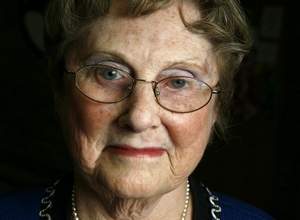
Eleanor Josaitis, "Detroit's Mother Teresa"

Eleanor Josaitis, “Detroit’s Mother Teresa” (1931-2011)

How can we (I write as a white middle-class able-bodied male citizen, enjoying just about every privilege American society has to offer) say “God loves you” to the oppressed? The daily life of an oppressed person is an experience—to quote Father Gustavo Gutierrez, Peruvian priest and founder of liberation theology—“of exclusion and nonlove, of being forgotten, of having no social rights.” What does it mean to tell an oppressed person that God loves them? I’m honored to have shared the space of mourning with the participants of Radical Shabbat, but I claim no special knowledge on the history and spirituality of Jewish anti-oppressive politics; I face this question as a Catholic. If the great truth of God’s love isn’t going to seem like an empty and meaningless piety in the face of the grinding reality of oppression, what actions must accompany it?

Father Gutierrez, who for fifty years has done his theological and political work in the slums of Lima, Peru, “between the sufferings and the hopes of the people with whom I live,” has a simple primary recommendation. Gutierrez writes that “Christian theology must be grounded in the reality of human suffering and exclusion if it is to be at the service of discipleship and transformation.” To follow Jesus’s teachings and to act from the trust of God’s abundant and self-communicating love means understanding that oppression is not fate, but a system created by people, and that the degradation and violence it forces onto the lives of the oppressed is “against the meaning” of the free, gratuitously beautiful gift of life. To me, Gutierrez’s recommendation leads to three conclusions.

First, Catholics must acknowledge that the suffering of the oppressed—the criminalization and state murder of young black men, the abandonment of the poor, the prohibitions against immigration even for those fleeing violence and poverty, the murder of trans people—is not merely a backdrop to their lives or ours, but a call to solidarity. As Christians, we find our fullest humanity in the radical love of our neighbor, and we affirm that we touch “the suffering flesh of Christ” himself when we minister to the most oppressed, when we strive to build their power and center their concerns.

Second, to follow the call of God’s love means following Jesus’s message toward social, not just individual, transformation. In the words of Pope Francis, “God, through Christ, redeems not only the individual person, but also the social relations existing” between all people. I believe that Jesus—by his words, actions, and life—teaches us that another set of human and political relationships is possible, one that refuses the “structural sin” in which those of us with privilege participate. What would this human-centered society, as opposed to a society of the marketplace imperatives and of state oppression, look like? It’s hard to even conceive of, but, in the meantime, it’s a truly radical assertion to center human dignity, autonomy, and freedom in our politics. When, as Pope Francis writes, “the categories of the marketplace” are made into absolutes, “God can only be seen as uncontrollable, unmanageable, even dangerous, since he calls human beings to their full realization and to freedom from all forms of enslavement.” This is a God I am glad to love.

Archbishop Oscar Romero of San Salvador (1917 - 1980)

Archbishop Oscar Romero of San Salvador (1917 – 1980)

Finally, to truthfully say to the oppressed (and show by action) that “God loves you,” I believe that we Catholics should courageously explore the consequences of what the Church calls its “preferential option for the poor.” Catholic theology defines this option as centering the needs, concerns, questions, and conditions of the poor in our faith life, and examining our society’s policies and institutions in terms of their impact on the poor. A shallow reading of this teaching simply suggests that “we” the church must minister to the needs of “them,” the oppressed. But, carried to its logical conclusion, this teaching can and should challenge Catholics to center the voices of those most affected by oppression when that oppression is being addressed.

What might this look like? Well, here in King County, youth of color are resisting—through education, protest, and direct action—the county’s plan to invest $210 million in a new youth jail; the community most affected by mass incarceration is speaking for itself and saying no. How can Catholics listen to these voices, and build their power over that of self-proclaimed experts and employees of carceral institutions?

Or, for another example: in a church that remains deeply sexist and exclusionary of queer and trans folks, how can those of us who enjoy gender and cis-gender privilege build the power of women and queer and trans communities, internationally and locally? For all his lucid and serious criticism of capitalist ideology, Francis’s opinions on reproductive choice, the role of women in the church, and the humanity of queer folks are largely awful, including his recent offhand comparison of modern “gender theory” to “nuclear arms,” for how both threaten to disrupt “the order of creation.” Liberation-oriented Catholics must clearly and definitively say no to such ideas, and the practices they lead to. Our call is not just to find common cause with oppressed communities, but to strengthen them by addressing systemic injustice and by centering these communities’ politics, cultures, and ways of knowing.

As Catholics concerned with a genuinely human-centered politics, our work must be within our faith communities as well as in the world as a whole. Authentic faith, Pope Francis writes, “is never comfortable or completely personal…. [It] always involves a deep desire to change the world, to transmit values.” And so, remembering the mourner’s kaddish, I grieve for the victims of police violence—and for the hearts of those officers who, for one terrible instant, were the state’s violence, fear, power-numbedness, and hatred personified. In this grief, I strive to act not because I feel morally superior, or because I feel the oppressed to be saints idealized by their suffering, or because I feel those who oppress are inhuman, but because God is good, and in the words “God loves you” I hear a call, impossible to ignore, to fight for the liberation of all people.

Comments Off on Repost: How Can We Say “God Loves You” to the Oppressed?

Filed under politics, spirit

The word “God” exists

Probably the mot important thing going on in my life which I have never written about here is my decision as an adult to convert to Catholicism. There is way more to this than a single blogpost, but I thought I’d start writing more seriously about my journey, for friends who I don’t see that often, as well as for folks whose backgrounds are like mine– lefty, punk rock, a product of Scandanavian Protestant family tradition, raised in a secular/Christian-hegemonic, appetitive, pyramided culture, groping for an authentic spirituality.

The title up there comes from German theologian Karl Rahner’s Foundations of Christian Faith, one of about five books that made it possible for me to decide to convert. The book is unbelievably dense; the translation is careful and business-like but with the bad habit of (seeming to) render Rahner’s monstrous German periodic sentences exactly into English. The chapter on God, “Man in the Presence of Absolute Mystery,” begins with a reflection on the word itself that I return to when friends ask me why on earth I would join an institution like the Catholic Church. (Please note that any misstatements or horrible dumbings-down of Rahner’s thought here are my responsibility alone.)

The word “God” exists. This, as a fact of our language, is worth thinking about. Unlike other ways of conceptualizing the divine– Lord, the Great Spirit, holy of holys, Adonai, Siva, the womb of love– “God” has no descriptive or metaphoric content: it points to nothing in the world. We might in an act or sign momentarily glimpse the action of another abstraction we believe in, such as truth or love, but the word “God” cannot be pointed to in instances. It simply stands (in distinction to even such abstractions as truth or love) as a sort of question about reality: it is everything beyond what we can identify, point to, strive toward, or name. The word “God” is rather the is-there-such-a-thing in whose presence, or upon whose ground, we do our pointing-to and striving. But as such, the question asked by the word “God” (says Rahner) points toward what is unique about humans.

So what is unique about humans?

Natural science has eaten the lunch of just about any earlier claim to human uniqueness: people are not unique among animals in acting compassionately, in showing grief, in communicating complex thoughts through sound. But what seems to be unique about humans, speculates Rahner, is our ability to reflect on the entirety of our lives and speculate what may lie beyond our limits: the limits imposed  by the conditioning experience and political history, and the limits of our powers of understanding. Our ability to reflect on our lives as a whole– how are my intimate relationships just shadows cast by my conflict with my parents? would I be happier if I exercised more often? would I be a bad person if I stole these leggings? why are some people happier in bare simplicity across the world than I am in my material comfort here? can I share without hope of recompense even though I’ve been taught life is war?— and then make a choice, is, for Rahner, the definition of human freedom. Freedom is the spiritual environment in which we decide and then take responsibility for that decision, not the mere fact of deciding to steal those leggings.

So: humans, in reflecting on the conditioning of their dark, hard, bitter, or irreconcilable histories or circumstances, can step beyond and transcend this conditioning. We can choose, in freedom, to be more or better than our apparent limits would allow us. God can be thought of (in Rahner’s phrase) as the term, or endpoint, of this or any possible transcendence, the absolute unknowable horizon-line past what can be conceived of in our frail and wandering little hearts. This makes “God,” for Rahner, an inextricable part of what is human about humans, definitional even in the psyche of someone who names and then denies the existence of this term of transcendence. To (probably mis)quote from memory: “Without the question represented by ‘God,’ we would cease to be anything but clever animals.”

The first “natural revelation” of God to a human– the first gift of the Spirit— lies in our being able to yearn for transcendence, regret or reflect on our past, formulate a question or longing about our lives as a whole. Rahner is a meticulous, unlyrical writer, temperamentally cautious, but some of his writing on this subject feels like it takes flight, as when he writes that the Spirit is “everything in the world that is constantly new and fresh, free and vital, unexpected and mighty, at once tender and strong… The Spirit can be perceived wherever people refuse by the grace of God to conform to legalistic mediocrity.” (Had this quote drawn back to my attention by Fanny Howe.) This yearning, and the self-renewal it allows, is a condition of our humanity that’s a sheer gratuitous gift. And this gift (for Rahner) is the first indication that God wants to be known– worshipped, contemplated in silence, honored by faith hope or love– by us fortunate apes.

So. This is one way of talking about God. It was the way that started me reading, writing, talking, trying to pray, and talking some more on the path that’s led to me being where I am now, enrolled in the Rite of Christian Initiation for Adults at St. Mary’s, learning words like thurible and ambry and memorizing prayers I’d already half-soaked-up in childhood. Bearing in mind how absurdly difficult it is to speak authentically about belief, I would love to talk to you all more about it. Look for more posts soon.

6 Comments

Filed under spirit