Category Archives: poetry

#tbt: Barbara Guest’s “Collected Poems”

Here’s a review I wrote for Pleiades (29.2: 2009) on the occasion of the publication of Barbara Guest’s mighty Collected Poems, edited by her daughter Hadley (who was also a fabulous resource for interviews, cool old photos and memorabilia, and uncollected texts which I refer to in the piece– thanks Hadley!).


DEFENSIVE RAPTURES: ON THE COLLECTED POEMS OF BARBARA GUEST


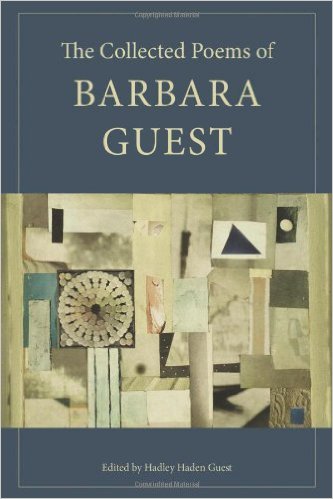
Barbara Guest, The Collected Poems of Barbara Guest

Edited by Hadley Haden Guest

Wesleyan University Press, 558 pages. $39.95

collected guestAt the crack of the 1950s, Barbara Guest moved to New York in a convertible. She was penniless, bringing along only her wits and a painter boyfriend she’d met through Henry Miller. She was a smart, reticent young woman, who wrote smart, reticent, painterly poems—a natural person of culture, an observer, an outsider. In the belly of the loud male-dominated scene of Abstract Expressionism, she took up art criticism; she married twice; she went to parties with Frank O’Hara; she drank at the poets’ bars and the painters’ bars; she befriended artists like Joan Mitchell, Helen Frankenthaler, and Mary Abbott; she wrote on their canvases or they worked side by side. The first poem in her first book (1960’s The Location of Things) drops the reader all at once into the astounding familiar:

Why from this window am I watching leaves?

Why do halls and steps seem narrower?

Why at this desk am I listening for the sound of the fall

of color, the pitch of the wooden floor

and feet going faster?

Am I to understand change, whether remarkable

or hidden, am I to find a lake under the table

or a mountain beside my chair

and will I know the minute water produces lilies

or a family of mountaineers scales the peak?

The answers to these questions—the forty-five years of poetry that make up Wesleyan’s new Collected Poems of Barbara Guest—are easy to miss at first look. In fact, Guest’s body of poetry is best characterized by what it leaves out. Her twenty-odd volumes siphon away assertion, scorn biography, challenge denotation, skip exposition, temper humor, and warp experience. What’s left is Imagination, the same visionary strain of Keats and Adorno, Stevens and Baudelaire; a pre-postmodern sort of ecstatic displacement, from the world of facts into the world of interrelation. Her work glows.

Although she shared a nest with the New York School poets—with Frank O’Hara, John Ashbery, James Schuyler, and Kenneth Koch—and although O’Hara was a passionate advocate of her poetry and a devoted friend, her poetics (or her “comportment,” in Susan Gevirtz’s phrase) fundamentally differs from theirs. She doesn’t fit in, and never founded, a particular avant-garde school. Her mixture of heavyweight aesthetic theory, gorgeous musicality, and a reticent, private voice has never really been emulated. Although the much-missed Sun & Moon Press afforded a national audience for her work from the late 1980s to the 90s, her early volumes have been hard to come by and her poems are underanthologized. There are other poets of Guest’s generation (Jack Spicer, Philip Whalen, Edward Dorn, Aram Saroyan) who have also been unjustly neglected. But Guest is a better poet than all of them, and this Collected Poems is a terrific volume gathered rather too late: after an unbelievably productive final fifteen years, Guest died in Berkeley, two years ago, at age 85.

Continue reading

Comments Off on #tbt: Barbara Guest’s “Collected Poems”

Filed under poetry

#tbt: American Poetic Hybridity, Then and Now

As Norton is pushing its new edition of Paul Hoover’s Postmodern American Poetry, it may be that the press’s 2009 anthology, American Hybrid, is vanishing into history. But this anthology–Cole Swensen and David St. John’s hypothesis of a contemporary lyric existing between “traditional” and “experimental” poetries–is still in the air. Contemporary big-press/big-prize American poetry is gravitating toward its own conception of “hybrid” poetry, a learned, skeptical poetic voice that steers carefully between James Merrill (in his virtuoso word-painting mode) and John Ashbery (in a fairly normy post-Stevens reading of that poet). This is a “hybrid” project if there ever was one–I think of Vijay Seshadri’s 3 Sections and Adam Fitzgerald’s The Late Parade as exemplars–and it suggests to me that this now almost-old-fashioned-feeling idea (whose “traditional”? whose “experimental”?) is still alive. With that in mind, I thought I’d repost a review of American Hybrid I co-wrote with the delightful and serious Michael Theune for Pleiades 30.2 (2010).


On American Hybrid: A Norton Anthology of New Poetry, Swensen and St. John, eds (Norton, 2009). A Critical Conversation by Jay Thompson & Michael Theune.

American Hybrid: A Norton Anthology of New Poetry anthologizes work that situates itself in the middle space formed by what is often conceived of as, as editor Cole Swensen calls it in her introduction to the anthology, the longstanding “fundamental division” in twentieth-century American poetry. Formulated in a variety of ways (Romantic vs. Modern; New Formal vs. Language), this division typically comes down to a divide between more mainstream, traditional poetries and more avant-garde, radically experimental poetries in what Swensen calls “the two-camp model.” According to Swensen, the poetry in American Hybrid is new insofar as it hybridizes “core attributes of previous ‘camps’ in diverse and unprecedented ways.” Swensen notes,

The hybrid poem has selectively inherited traits from both of the principal paths… Today’s hybrid poem might engage such conventional approaches as narrative that presumes a stable first person, yet complicate it by disrupting the linear temporal path or by scrambling the normal syntactical sequence. Or it might foreground recognizably experimental modes such as illogicality or fragmentation, yet follow the strict formal rules of a sonnet or a villanelle. Or it might be composed entirely of neologisms but based in ancient traditions. Considering the traits associated with “conventional” work, such as coherence, linearity, formal clarity, narrative, firm closure, symbolic resonance, and stable voice, and those generally assumed of “experimental” works, such as non-linearity, juxtaposition, rupture, fragmentation, immanence, multiple perspective, open form, and resistance to closure, hybrid poets access a wealth of tools, each one of which can change dramatically depending on how it is combined with others and the particular role it plays in the composition.

American Hybrid brings together the work of 74 contemporary poets whom the editors believe have been doing such hybrid work, presenting each poet with a brief statement about their work, a paragraph of professional biography, and a sampling of approximately six pages of poems. According to St. John’s introduction, all of the poets included in the anthology had three books published when reading for the anthology began in summer, 2005. Many of the anthologized poets are well-known, including Rae Armantrout, John Ashbery, Mary Jo Bang, Norman Dubie, Alice Fulton, James Galvin, Forrest Gander, Albert Goldbarth, Jorie Graham, Barbara Guest, Robert Hass, Lyn Hejinian, Brenda Hillman, Ann Lauterbach, Harryette Mullen, Michael Palmer, D. A. Powell, Bin Ramke, Claudia Rankine, Donald Revell, Rosemarie Waldrop, Marjorie Welish, C. D. Wright, Charles Wright, and Dean Young. But American Hybrid also includes some relatively younger poets and/or lesser-known poets such as Joshua Beckman, Molly Bendall, Killarney Clary, Martin Corless-Smith, Andrew Joron, Myung Mi Kim, Stefanie Marlis, Jane Miller, Jennifer Moxley, Rod Smith, Dara Wier, and Elizabeth Willis.

The following conversation took place via e-mail during the fall and winter of 2009-2010.

Continue reading

1 Comment

Filed under poetry

New work online

Thanks to my old friend and gimlet-eyed reader Chris Robinson for soliciting work from me for thethepoetry.com. Dig it here, but don’t stop digging until to get all the way to Michael Rae’s poem comics and Rich Armstrong’s melancholic late-night QVC rages.

Comments Off on New work online

Filed under poetry

“…the male experience and the male perspective is still seen as more universal, more public, than the female.”

This huge and brain-stimulating list has been making the rounds online and I thought I’d share. Vela magazine compiled a list of non-fiction (short-form essays, travel writing, science writing, memoir, political essay and more) by women, almost all of it available online. The editors write:

We know, sadly, how much easier it is to pack a syllabus or an anthology with male writers, and so this list is meant to serve as a reminder of the abundant, stellar nonfiction by women, and a sort of huh-uh! to excuses about not being able to find enough work by women writers.

Dig it!

Comments Off on “…the male experience and the male perspective is still seen as more universal, more public, than the female.”

Filed under poetry, politics

I don’t agree with all the places Ron Silliman goes on to take this argument, but I still appreciate his note that

There is no such thing as poetry, only kinds of poetry.”

Comments Off on I don’t agree with all the places Ron Silliman goes on to take this argument, but I still appreciate his note that

Filed under poetry

A Naptime-Length Notes on Wallace Stevens (2)

Wallace Stevens was idealistic, head higher in the glowing empyrean than any poet but Shelley, adamant about poetry’s nobility and its force. A poem’s subject, he reminded his readers, is not its fixed objects, but “the life lived in the scene they compose.” Complementarily, our souls consist of our externals, animated by the imaginative principle: “There are men of a province / Who are that province.” In his prose work The Necessary Angel—and in the more explainy poem-essays—Stevens characterizes poetry’s internal violence as a pressure of that imaginative principle back against the pressure of the bare fixed facts of the world in on us.

But Stevens’s poetry also reflected the political, artistic, and cultural limitations of this definition. It really is often gaudy: brightly colored and small-seeming, scrubbed of other real people and their complementary nobilities, forces, and powers. The poems can feel dioramic, to quote one of my old teachers, the poet Michael Palmer. They’re full of bright miniatures: “Toward the cool night and its fantastic star, / Prime paramour and belted paragon,” or “The silver-shapeless, gold-encrusted size / Of daylight,” or “He sat there reading, from out of the purple tabulae, / The outlines of being and its expressings.”

Stevens’s ideas, then, appear more often in emblems than in things. More particularly, sometimes, in emblems of a certain sort of nasty exoticism. Tropic isles, bejeweled native palaces, country “darkies” (or “negresses” or “blackamoors” or, unbelievably, the decorations of a “nigger cemetery”), Indian chieftains, sunlit Asias, all are selected by Stevens for their distance from the fixity of Hartford. They stand for the far gleaming plunder of the mind, the sort of noble visions the imagination can conjure; not people, not places. Brazil with “her serpents” and “avoirdupois” might as well be a palace on the Moon, for neither feels real.

His poetry’s thesis—that the poem can ignite and animate reality and invite us into the grand, impossible, and timeless—is often instantiated in the same materials as fed generations of Orientalist, racist fancy in Europe and America. Stevens’s foil, complement, and friend, the poet William Carlos Williams, had his own imaginative and political blind spots. But at least he had real people in his poems. The “we” Stevens intended, when he wrote that poetry’s music “helps us to live our lives,” wasn’t that big.

—But here I go, knocking the dreamy dead! When the question underneath for me is: How can one accountably bear witness to poetry? I spent years thinking that, since my favorite poets filled me with a sense of wild child-like freedom, poetry must occupy a space in us free of all of reality’s oppression, mundanity, uneven privilege, rage, and heartache. I don’t believe that any more. I still believe that the poems I love invite me to an experience as if it were mine—“a remembrance of my own”—but I don’t believe anymore that poetry can step over ugly preconceptions, unexamined privilege, and plain power.

I don’t believe as poets that we can have it all, either—that late-capital’s teeming has dropped every form and image from history in our lap for the selecting, mirroring, editing, or ironizing. We’re not that big, not that smart, not that right. I don’t know what comes after this, but I’m going to try to listen.

Comments Off on A Naptime-Length Notes on Wallace Stevens (2)

Filed under poetry, politics

A Naptime-Length Note on Wallace Stevens (1)

Reading happens in naptimes and in the hour and a half between when Finn falls asleep and when we do. It’s brief, appetitive, mood-driven. Cait’s managed to finished four novels since he was born, but I hardly have the patience: who knows what I’ll like or need in tomorrow’s minutes?

The last few days I’ve come back to a poet I’ve loved and raged against alternately, for the whole decade I’ve read poetry at all: Wallace Stevens. Do his poems ever seem gaudy to you? Sententious in their claims about what poetry is and is for? Do they sometimes also seem free and wild and beautiful?

Ending Stevens’s Collected is a set of twenty-five poems called The Rock, end-of-life poems mostly free, thank God, of the disquisitive “Notes Toward…” manner of the long middle works, plainer and sadder and more personal. “His mastery,” he writes of someone much like himself, “[l]eft only the fragments found in the grass.” Or the metaphor-nester interrupting his poem with a sudden fear that “the object with which he was compared / Was beyond his recognizing.”

For the ten years I’ve read my paperback Collected (starting by dogearing “The Emperor of Ice Cream” and the poems Randall Jarrell told me to like, then tearing receipts up to mark the passages or phrases I wanted by heart—“Forms, flames, and the flakes of flames” or “Fat! Fat! Fat! Fat! I am the personal!” or “You dweller in the dark cabin…”), I’ve read The Rock a half-dozen times. But, as I guess with any poet I really love now, I can spend years beforehand doing a sort of reading that’s really a getting-ready-to-read. I poke around a set of poems: hoping for a familiar cadence and perspective, marking my return way mentally: on a decadelong first date. Then, suddenly, there’s the work.

You know the feeling. What makes it come? Maybe it’s when the small advances, the poet’s revelation or bewilderment that constitute the poem (was that scrawny cry at dawn only in my mind? or was it out the window, calling the sun up?), become my own: when the poem’s feeling is one I recognize recognizing. It took Stevens seventy years of life to write The Rock and I feel grateful and dumb and lucky that after twenty-nine years I have these poems to recognize myself in:

You were not born yet when the trees were crystal

Nor are you now, in this wakefulness inside a sleep.

Or how about:

His self and the sun were one

And his poems, although makings of his self,

Were no less makings of the sun.

Maybe it was a middle-class liberal-arts smugness, but I always used to think that Stevens was the best thing to ever come of out the insurance industry. How could someone with a closet of a gray flannel suits have dressed himself “in an orange gown, / Drifting through space”? I think now that I was being juvenile then; any heart is capable of that drift and efflorescence, maybe incapable of stamping it out in itself, maybe responsible to it.

And, re-reading next to a sleeping baby, I was reminded by Stevens how nice it is that poetry (even extremely analytical poetry) so often reminds itself that it’s made of words, not rhetoric or logic. I can wonder why, in “The Poem as Icon,” Steven’s symbolic logic dictates that  “it is not enough to cover the rock with leaves,” but, in The Rock’s orderly stanzas, Stevens still bursts out with lines like “the ripe shrub writhed,” or “blue broke on him from the sun, / A bullioned blue, a blue abulge.” The concrete material of his poetry isn’t argument, but sound. And who can help themselves before words, delicious, rare, inadequate, death-encircled, tiny words!

Comments Off on A Naptime-Length Note on Wallace Stevens (1)

Filed under poetry

Forking Paths: on Gene Wolfe’s “Book of the New Sun”

This week I have to return its first two volumes to the library, so I figured I’d write about Gene Wolfe’s Book of the New Sun. It’s a fantasy series and (now that I’ve read them twice, I can probably fess) one of my favorite sets of books. Set on a dying future Urth, under a dimmed sun “with a worm in its heart,” New Sun is the story of an exile from the guild of torturers, Severian, and his journey to becoming the Autarch, the master of Urth’s biggest kingdom.

There are countries and literary climates where genre literature is just literature. America now isn’t, quite, despite the spate of “post-genre” writing from MFA programs and from writers like Kazuo Ishiguro, China Mieville, Jonathan Lethem, and Margaret Atwood. Anyway, Wolfe seems too happy in wide-angle high-genre writing (and probably too big a G.K. Chesterton fan) to ever be read as a forerunner to the hip style now called “New Wave Fabulism.” His subtle, somewhat Modernist, allusive and fantastically inventive fiction—like that of Joanna Russ, maybe, or Cordwainer Smith—exists in a funny in-between environment, the space reserved for “writers’ writers.”

(This isn’t to say Wolfe is an academic. Wolfe—admirer of Proust and Borges, Korean War veteran, and one-time Buckley conservative—couldn’t quit his day job as a plant engineer (he spec’d out the machine that made possible the Pringles potato chip!) until the success of this series.)

By repeated exposure, readers like me have gotten used to stories that are long and fantastical also being epic—stories whose hearts are in heroism and world-shaping deeds. New Sun has both, but it’s fundamentally a weirder narrative than that, bigger and smaller than the epic. It’s a story about stories. Severian is a chilly, emotionally guarded and occasionally unreliable narrator—a Nabokovizing of, say, Aragorn or Conan—and readers will miss major shares of the story if they don’t attempt to see past his misdirections and oversights. His backwards-to-the-throne journey depends on coincidence, intervention, and divine do-overs: it’s more “Garden of Forking Paths” than The Golden Compass. A dozen chapters of New Sun are given over to folktales, legends, plays, and symbolic dreams.

New Sun’s shape is also not that of the epic: Severian’s journey differs from that of the usual chain-breaking liberator. At the book’s conclusion, we’re left with a world whose stagnation may simply have to continue. Fully self-creating spirits, in Wolfe’s cosmogony, are dangerous; they’ve harmed us humans in the past and would again. It’s the fate of most humans to labor for forces whose heart and motives are not intelligible.

If this theological bent is starting to sound familiar: Wolfe has identified himself in the past as a Thomist Catholic, a philosophically rigorous branch of the church that concerns itself with the essential mystery and oneness of God, and with the possibility of salvation through knowledge. Yet, whatever our learning, we humans express a will that we can’t understand. “He is thy being,” wrote one Thomist mystic, “but thou are not His being.” The concluding revelations of the series’s final volume, The Citadel of the Autarch, are more exegetical than fantastical. Behind Wolfe’s torrent of new-old coinages, the terms for the divine entity—“the Increate,” “the Pancreator,” “the Panjudicator”—would be recognizable to most Christians.

Wolfe’s prose is often beautiful, and his sense of invention felt as magnificent on re-reading (I’m saying it!) as do my childhood memories of Tolkien’s or Lewis’s. There’s a magic sword, godawful-looking creatures from another world called cacogens, a big reveal of a secret mad scientist (not who you’ll expect), cruel kings from Urth’s forgotten past, and a creature called the alzabo that eats memories along with bodies.

The cultures of Urth are also refreshingly complex. Rather than the usual endless-Europe-plus-dragons, Wolfe’s world is in parts Byzantine, Orwellian, and Tang Chinese, ways of life that feel lived in from inside. In his world, it’s a historical curiosity that humans used to be divided by skin color. Several characters are descended from Korean spacefarers; Severian, tall, dark-haired and with light brown skin, doesn’t seem to be a typical white sword-swinger. Nonetheless, was it necessary that the natives (sorry, “autochthons”) of his continent—probably South America, by narrative clues—be “squat, dark,” and savage? Or that female character after female character (of fantasy-standard flowing hair and heaving breast) swoon ripely for Severian?

Genre writing would seem, by its nature, to expose to high contrast the knobs and pitfalls in an author’s imagination. We notice, say, a sexist trope more quickly in a world that’s largely invented. Likewise, the more detailed Wolfe’s theologoumenon (see the quote introducing this site), the more a disaffected atheist reader finds to irritate her. But New Sun’s inventions aren’t all high-drama, clash-of-kingdoms stuff. The books are full of casual, eerie details. Iron is a precious metal in this dug-out planet, the Moon is green with cultivation, rats and wolves can read and write, and the mountains are all carved with faces of forgotten rulers. And did you know, mentions one character, that the sun used to bright enough that the stars weren’t visible during the day?

The book bears—demands, maybe—re-reading. (Some questions that hung from one reading and got clearer, maybe, in the next: Who is Severian’s mother? What’s going on between Hethor and Jonas? Who was Apu-Punchau? What is the Autarch’s name? Why introduce a little boy also named Severian? What is being guarded in the mine at Saltus?) I can think of only a few novels—At Play in the Fields of the Lord, maybe, or The Sheltering Sky—that gave me so much more on a second time through.

Any fans or skeptics out there have a thought?

2 Comments

Filed under poetry, spirit

Book review: Alice Notley’s “Reason and Other Women”

Like last week’s Rosselli piece, this essay originally appeared in Pleiades 31:2, the newest issue of a terrific magazine. Enjoy! Leave a comment!

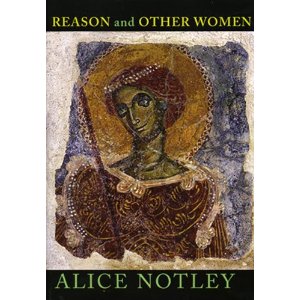
Notley, Alice. Reason and Other Women. Chax Press: Michigan, 2010.

Alice Notley is contemporary American poetry’s anti-celebrity celebrity. Eloquent, formally diverse, and vehemently un-modish, Notley takes seriously poetry’s commitment to tell the truth with “new and honest words,” and has no patience for contemporary American poetry’s received forms of homily, performance, or satire. A veteran of the Second New York School poetry community, her work is unsentimental about avant-gardes and downright contemptuous of mainstream artistic success. Her older poem “1992” lists NAFTA and the CIA alongside the Academy of American Poets and the Pulitzer, writing “who wants [poetry] in a world / where all art’s patently successful / ratified by treaty and packaged by conglomerate” (Notley Grave of Light 252). She’s fond of quoting, instead, Frank O’Hara: “The chair of poetry must remain empty, for poetry does not collaborate with society, but with life!”

The volatile energy of Notley’s poetry—even if you can’t follow her, you believe her—has a backwards shadow in a career-long overproduction. Certain of her formal ideas have spun out entire books: avant-garde theory looks distrustfully at the written “I,” so she produces a first-person verse memoir, Mysteries of Small Houses. Or Notley’s identification of a political problem demands a response: the limited body of the female epic leads to her mighty Descent of Alette. Or, in her 2010 collection Reason and Other Women, the conceit of the mind as a Byzantine church fosters a huge book (191 pages) of entering the sanctum, addressing the dead, and creating through mosaiced materials.

Reason takes its own process as subject but, paradoxically, it rarely speaks of writing. The problem with words, in Reason, is that they are of the future and past, and the book’s farther-and-farther leads inward, not forward: “there is no next in this church” (55), Notley writes. Instead, the poet’s referent arts (gifts?) are mind-reading, dream, and mosaic. The past here is nothing but a story, and stories are bodies: figured, animate, present things.

going out years of words old to continue in the path of my nonfortune in this vast

continuum this infinite untimed experience the eddying river where what waters

where who knows. who knows where the earth is, what is lit mind

and the figures there (32)

In Reason, Notley takes mind-to-mind communication and mosaic as far as a book made of words can, into plain deep-psyche blurt and irregular structures of units-not-images. No reader will doubt Notley’s commitment to her mode of expression here, between titles as simple-minded as “The Scary Old Building” and passages of such singing seeming-heedless sublimity:


fascinting fascinating light of non doom, no doom

mood nair thedniw, come come, hop to in, in the kitc kitchen of breaking cant break it

the good these piece not really a broke al at all, know gla what do the dead say,

mouths frozen throats vibrant they say in the field, near those houses at the border,

in the light of the game where no ones playing, that struggles are becoming nothing, as

we die into a ring around the black sea full

of fish like us (30-31)

But such moments are more than balanced by many weirdly draggy passages in a similar manner, improvisational without vitality:

i said a low that is a car why say low instead of car a car rental low rental service and then pushin my babe toward the narrow and who would aid there but i get my own door i find my own door to door im not sure exactly but its dimensions or definition… (133)
The book is nervy, exemplifying Notley’s career-long commitment to expanding the poetic into new material, without always paying off. Speaking of nerves: Notley writes in Reason’s preface that, by slowly reading “word by word” the work at hand, “you [the reader] can enter a plane above society’s killing demands and live in ‘mind,’ at least temporarily” (7). The tone of such an introduction—could you imagine, say, Sharon Olds introducing her work in the same way?—gives the reader an idea what to expect from Reason.

The book, with its long prose-y lines and pileup of character archetypes, takes on the quality of a loose narrative. The closest Reason comes to the epiphanic lyric is in the middle of Part I, with two consecutive shorter (by this book’s standards) poems, “The Body Is in the Soul” and “The Figure of Reason.” The former, its title inverting the scientific-rational commonplace, drags the speaker to a torn edge in herself. There, the female figure of Reason, Notley writes, “casts a light” (44), while a male Chaos sings of images “when he fucks” (44). In “The Figure of Reason,” Notley’s speaker cries out:

reason speak to me what sort are you who are

in the corridors of my body

a light in which to know or discover, the city

a city but why, because it keeps calling on the horizon….

only reason is intelligent, only reason loves deeply, only reason can deal with notions

of purity and impurity, cementing them into the shapes of the world (46)

Seen through these lines, Reason’s formal choices make a physical sense: the language’s occasional violence, the material’s broken edges, take us to a place where (mosaic-style) one piece is roughly fitted to another. The titular Reason isn’t a shorthand for rationalism, but the animating female presence of concrete making. Only disjunctions unify: this statement is political, not just aesthetic.

Taken as a whole, Reason is daunting, exhausting, profound, and not quite worth it—a frustrating, deeply-felt attempt to reimagine old interior journeys in a new manner of expression. In Reason, Notley has chosen interruption, overspill, and self-half-revision over the poetry of perfected symmetries, the works of “men rich in images” (45). But she doesn’t want to kill traditional Orphic eloquence; the book’s commitment to joining-together is anti-Maenadic. Notley seeks wholeness. (And she’s still looking: as of press time, Notley has published two more collections of poetry, Culture of One and Songs and Stories of the Ghouls, since Reason.)

In her essay “Thinking in Poetry,” Notley once wrote that “the ‘I’ I most prefer sits serenely and somewhat numinously behind my personality, behind a sort of window, watching the chaotic and distressing events of the world.” There’s a lot of chaos and distress in Reason, but there’s also companionship (if there’s one thing Notley’s imaginative works teach us, it’s that privacy isn’t empty; figures appear, lunge, and flicker out like shadows even in the inner sanctum of her imagination) and bright light.

Comments Off on Book review: Alice Notley’s “Reason and Other Women”

Filed under poetry

Jupiter up, higher and more southerly the last few weeks, and Rigel and Betelgeuse, the winter stars you forget, through the thinnest of clouds. Cait’s very pregnant now, her belly button half-out and belly taut; I help her out of chairs. I haven’t been publishing here in part because my energy is other places: activist work has me thinking about how I can teach through service instead of opinions. Striving to be alert, show up, be humble, sit with my feet closer together, modulate. When I feel the most hopeless—the week of Obama’s shit debt-ceiling deal, the night the cops klieg-lit Westlake Plaza and dragged the Occupiers out of their tents—I think of what my dad told me, “the new society is being born inside the old one.” Activism as creating the beloved community, not in some emerald-lit down-the-line time, but in moments and encounters here and there in this very life we’re living now. And my own child, quiet then busy in Cait’s body, motions only now volitional, able to hear me play Lester Young and Jherek Bischoff records and maybe wake up to my voice, born in a world of Tumblr feeds and topsoil erosion and soldiers fertilizing the desert. Dear commitments. Sara Grant, RCSJ,—I was put on to her by Fanny Howe’s prose book Winter Sun—says Catholics should admit not knowing what God has in store. They must no longer take for granted “as still sufficient for us today the myths and symbols which satisfied older and less scientifically sophisticated generations than our own, who moreover recognized them for what they were—myths and symbols which had to be transcended.” Theology which isn’t “reborn in every age and culture in terms of contemporary human experience” isn’t theology; it’s necrophilia and Odin-talk. “Eye has not seen, nor ear heard.” Salvation through knowledge: my baby doing somersaults, a flooded field, my hairline receding and this rind of moon catching light. In “Of Soul and White Folks,” Mabs Segrest calls whiteness an anesthetic—a chosen inability to feel and connect that numbs even our connections with other whites—and racism a form of paranoia, an externalizing of an internal unease and terror. We live this way and are unable even to mourn. To share in the world’s self-knowledge will bliss and break us, says the vinegar-smell of my block’s rotting apples. The last lines I loved, Whitman: “If you would understand me go to the heights or water-shore, / The nearest gnat is an explanation and a drop or the motion of water a key, / The maul the car and the handsaw second my words.” I’m waiting for a poet who won’t simply repeat the horror and disorientation of the world to me, but will take them as the givens to underline a poetics of joy. Or a poetry of the encounter with Mystery that invites us to join the encounter rather than to worship it. Jupiter like a friend you run into at the grocery story, a book by firelight: Sara Grant says what “rivets” modern readers of the Upanishads is their sense of “me now,” with all history scraped out. Who wouldn’t see their own son in their arms when they read a sentence like “the knower of Brahman enjoys all delectable things simultaneously, as amassed together through a single moment through a single perception which is eternal, like the light of the sun,” blind cavefish and aggregates of stellar dust?

1 Comment

Filed under poetry, spirit